Cloud solutions on AWS, Azure & GCP: AI, IoT, containers, and security
January 13, 2026 • Updated September 27, 2026 • Published by Kishan Prajapat, SEO & Content Lead
Drafted with Citeya, an AI writing tool built by KPThink.
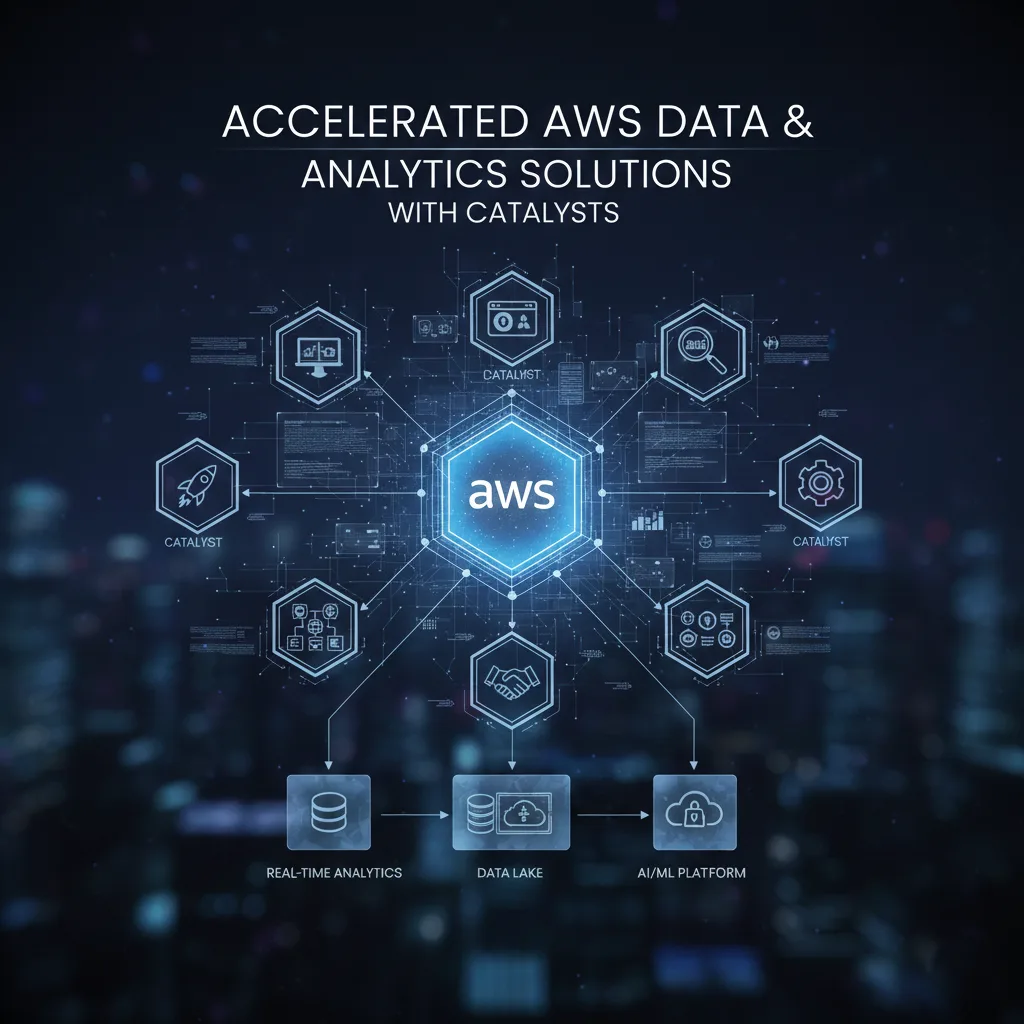
Image made with AI for visual purposes only.
AWS, Azure, and GCP each offer a large and overlapping set of managed services. Choosing between them is rarely about which platform is "better" in the abstract. It's about which services match your workload requirements, your existing licenses, and your team's expertise. This article maps specific services across the three platforms for AI/ML, IoT, big data, containers, and security, so you can compare them directly.
What to evaluate when choosing a cloud platform
- Which specific services address your workload (not just platform-level marketing)
- Existing Microsoft, Google, or Amazon relationships and license agreements
- Your team's current skill set: operational overhead differs by platform
- Data residency and compliance requirements (region availability varies)
- Ongoing cost structure: reserved pricing, savings plans, and egress charges differ
Not sure where your cloud setup stands?
Cloud capabilities by technology area
1. Artificial intelligence and machine learning
All three platforms offer managed ML training and deployment, so the decision comes down to tooling depth and integration with your data stack:
AWS SageMaker provides end-to-end ML workflows: data labeling (SageMaker Ground Truth), notebook environments, distributed training, model registry, and real-time inference endpoints. Rekognition handles image and video analysis. Lex builds conversational interfaces.
Azure Machine Learning integrates with Azure DevOps for MLOps pipelines, supports automated ML (AutoML), and connects to Microsoft Purview for data governance. Azure AI services (formerly Cognitive Services) provide pretrained models for vision, language, and speech without requiring custom training.
Google Vertex AI consolidates Google's ML tools (previously AutoML and AI Platform) into a single service. TensorFlow originated at Google, so GCP's tooling around it is deep. BigQuery ML lets you train models directly inside the data warehouse using SQL.
2. Internet of Things (IoT)
Cloud IoT platforms manage device connectivity, message routing, and edge processing at scale:
Azure IoT Hub handles bidirectional device communication with support for MQTT, AMQP, and HTTPS. Azure Digital Twins models physical environments as a graph, useful for manufacturing and building management scenarios.
AWS IoT Core routes messages between devices and other AWS services using rules. Device data can be routed on to Kinesis, Lambda, or S3 for processing (AWS IoT Analytics reached end of support in December 2025). IoT Greengrass extends AWS compute and ML inference to edge devices.
Google Cloud retired its IoT Core service on August 16, 2023. On GCP, device data is now typically ingested through partner IoT platforms or directly into Pub/Sub, so plan for that extra integration work on new IoT projects.
3. Big data analytics
The right choice depends on whether you prioritize SQL-first querying, streaming, or unified batch-plus-stream processing:
Azure Synapse Analytics combines a SQL data warehouse, Apache Spark, and data integration pipelines in one service. It integrates directly with Azure Data Lake Storage Gen2 and Power BI.
AWS offers a set of purpose-built services: Redshift for SQL data warehousing, EMR for managed Spark and Hadoop, Kinesis for real-time streaming, and Glue for ETL pipelines. The ecosystem is broad but requires more assembly.
Google BigQuery is a serverless, columnar data warehouse that scales query compute independently of storage. It's particularly fast for ad-hoc SQL on large datasets and integrates natively with Vertex AI for ML on tabular data.
4. Cloud-native development and containers
Kubernetes is available as a managed service on all three platforms, differing mainly in cluster management experience and ecosystem integrations:
Azure Kubernetes Service (AKS) integrates with Microsoft Entra ID (formerly Azure Active Directory) for cluster RBAC, Azure Monitor for logging, and Azure DevOps for CI/CD. It supports Windows containers natively, which matters for .NET workloads.
AWS Elastic Kubernetes Service (EKS) integrates with IAM, ECR (container registry), and ALB (load balancer). Fargate removes the need to manage worker nodes directly.
Google Kubernetes Engine (GKE) has the deepest Kubernetes integration. GKE was the first managed Kubernetes service, and Google contributes heavily to upstream Kubernetes. Autopilot mode manages node provisioning automatically.
5. AWS key services
Amazon RDS: managed relational database supporting PostgreSQL, MySQL, SQL Server, and Oracle. Multi-AZ deployments provide automatic failover.
Amazon SageMaker: end-to-end ML platform from data preparation through deployment and monitoring.
AWS CloudFormation / CDK: Infrastructure as Code tools for defining and provisioning AWS resources programmatically.
6. Microsoft Azure key services
Azure App Service: platform-as-a-service for hosting web applications and APIs without managing server infrastructure. Supports .NET, Node.js, Python, PHP, and Java.
Azure SQL Database: fully managed SQL Server with built-in high availability, backups, and threat detection.
Azure IoT Hub and Digital Twins: device management and physical environment modeling for industrial and building automation scenarios.
7. Google Cloud Platform (GCP) key services
BigQuery: serverless data warehouse with in-place analytics. No infrastructure to provision; you pay per query or reserve slots for predictable workloads.
Vertex AI: consolidated platform for building, training, and deploying ML models. Includes AutoML, custom training, and a model registry. Integrates with BigQuery ML for SQL-based model training.
Cloud Functions and App Engine: serverless compute for event-driven workloads (Cloud Functions) and fully managed application hosting (App Engine). Neither requires managing servers or containers.
8. Security tools across AWS, Azure, and GCP
Each platform provides threat detection, vulnerability management, and compliance monitoring. The tools differ in scope and integration:
AWS GuardDuty uses ML to detect anomalous behavior across CloudTrail logs, VPC flow logs, and DNS logs. AWS Security Hub aggregates findings from GuardDuty, Inspector, and third-party tools into a central view.
Microsoft Defender for Cloud (formerly Azure Security Center) provides continuous security posture assessment, just-in-time VM access, and integration with Microsoft Sentinel for SIEM. It also covers multi-cloud environments, extending to AWS and GCP workloads.
Google Security Command Center detects misconfigurations, vulnerabilities, and active threats across GCP resources. It integrates with Google Security Operations (formerly Chronicle), Google's SIEM, for security event analysis.
All three platforms provide encryption at rest and in transit by default. The shared responsibility model applies across all: the platform secures the infrastructure; you're responsible for identity configuration, network policies, and your application layer.
9. Hybrid and multi-cloud
Most enterprise environments don't run purely on a single cloud. Options for connecting on-premises and cloud:
Azure Arc extends Azure management (policies, RBAC, monitoring) to on-premises servers, Kubernetes clusters, and even AWS or GCP resources.
AWS Outposts deploys AWS compute and storage hardware in your data center, running the same AWS APIs locally.
Google Distributed Cloud extends GCP services to on-premises environments via dedicated hardware appliances.
Multi-cloud adds operational complexity: each platform has different IAM models, pricing structures, and tooling. Most organizations benefit from running one primary cloud platform well before adding a second.